Wednesday, September 20, 2023

Canada's Deserts


https://books2read.com/u/bapW6a


https://books2read.com/The-Travelling-Detective-Boxed-Set

Canada’s Deserts

Only forty-one of the one-hundred ninety-five countries on this earth have deserts but the deserts cover almost one-third of the earth’s land mass. I am a Canadian writer and all my mystery, historical, romance, and young adult novels are set in Canada. Canada is the second largest country in the world and home to one desert and three pseudo-deserts. A pseudo-desert is defined as an area that has some of the qualities that make up a desert, but does not meet the technical standards to be termed a true desert

There are three main features of a desert: less than 250 millimetres (10 inches) of precipitation each year; sparse vegetation; and severe weather changes. Other characteristics include humidity, high winds, little cloud cover, and aridity. The types of deserts are semi-arid, cold, coastal, and hot and dry.

The people of the Southern Interior of British Columbia claim that Canada’s only desert is in the Osoyoos area. Many of the businesses in the region have the word ‘desert’ in their names, such as the Nk’Mip Desert Cultural Centre and the Osoyoos Desert Centre. Tourists come to this part of British Columbia to see this popular desert.

But others say that, although it does have desert type plants like cacti and animals such as the sage grouse and tiger salamander, it is not really a desert because of the precipitation which is 323 mm (12.7 in) annually. It is defined as a pseudo-desert.

Another pseudo-desert in Canada is the Carcross Desert, located outside the community of Carcross in the Yukon. At 2.6 sq km (1sq mi) it is called the smallest desert in the world. But while it is termed a desert it is actually the remains of an ancient glacial lake which left the sand dunes when it dried up. In spite of the strong winds from Lake Bennett which bring in more sand, kinnikinnick, Yukon lupine, Baikal sedge, and lodgepole pines are able to survive.

The local people used the dunes for sandboarding, hiking, beach volleyball, and all-terrain vehicles and there are scenic tours for tourists.

The third pseudo-desert in Canada is the Great Saskatchewan Sand Hills covering 1,900sq km (734 sq mi). Like the Carcross Desert they are desert-like sand dunes situated just north of the village of Sceptre in southwestern Saskatchewan. Also like the Carcross Desert, the hills were left when glaciers melted 12,000 years ago and are home to a variety of plants and animals that have adapted to the dunes.

The Canadian Arctic Tundra is considered the only true desert in Canada. However, it isn’t a hot desert; it is a cold polar desert and covers a large area in northern Canada. The land is covered by thick layers of ice instead of sand and has a cold, harsh climate with temperatures dropping as low as -40 degrees Celsius (-40F). Trees have a difficult time surviving in the permafrost during the short growing season so the tundra is covered mainly by small shrubs, mosses, and lichens. A number of animals--arctic hares, muskoxen, polar bears, arctic foxes, and caribou--manage to live in this cold desert in the far north because they have thick fur coats to keep them warm.

Tuesday, September 5, 2023

National Holidays


https://www.amazon.ca/Killer-Match-Joan-Donaldson-Yarmey/dp/1990086241


 https://www.amazon.com/Sleuthing-Klondike-Canadian-Historical-Mysteries-ebook/dp/B0C18F5D72/ref=sr_1_1?qid=1685272048&refinements=p_27%3AJoan+Donaldson-Yarmey&s=books&sr=1-1#customerReviews
 
National holidays are sanctioned by each country’s government and are devoted to famous persons or events. There is usually one a month and most workers have the day off to celebrate it. However, it is a little known fact that each day of the year is dedicated to some animal, or food, or activity. None of them is a recognized holiday but they are worth acknowledging. Here are the ones for the last twenty-one days of summer.
Sept 1- World Letter Writing Day.
Sept 2- National Blueberry Popsicle Day.
Sept 3- Skyscraper Day
Sept 4- Newspaper Carrier Day—I don’t think there are many of them left.
Sept 5- Be Late for Something Day—Maybe don’t make that work, your boss might not agree that it is a real holiday.
Sept 6- Read a Book Day. I am a writer so I sanction this holiday.
Sept 7- National Salami Day.
Sept 8- Pardon Day. As in “I beg your pardon ‘ or as we say here in Canada ‘Sorry’.
Sept 9- Teddy Bear Day. How many still have their childhood teddy bear?
Sept 10- Swap Ideas Day—make sure they are good ones.
Sept 11- Make Your Bed Day.
Sept 12- Chocolate Milk Shake Day. My favourite.
Sept 13- Fortune Cookie Day.
Sept 14- National Cream Filled Doughnut Day.
Sept 15- Make a Hat Day.
Sept 16- Collect Rocks Day—take a pail.
Sept 17- National Apple Dumpling Day. Yummie.
Sept 18- National Cheeseburger Day.
Sept 19- International Talk Like a Pirate Day—Arrgh
Sept 20- National Punch Day—I’m thinking the drink.
Sept 21- Miniature Golf Day.
Welcome to Autumn.

Friday, July 21, 2023

My Historical Yukon Novels


https://books2read.com/Sleuthing-the-Klondike

https://books2read.com/Rushing-the-Klondike


https://books2read.com/Romancing-the-Klondike

BWL Publishing Inc. published twelve books of the Canadian Historical Brides Collection in 2017, Canada's 150th birthday. Each book was set in one of the ten provinces or two territories (Northwest Territories and Nunavut were combined). Because I had travelled to the Yukon twice and had hiked the Chilkoot Trail on the hundredth anniversary of the Klondike Gold Rush in 1997, I chose the Yukon of 1896/97 to write about. My novel, Romancing the Klondike, was published as a hard copy and ebook in 2017 with an audible version being released in 2022. It follows the lives of two young women who travel from Halifax to Fortymile on the Yukon River in 1896.

Pearl Owens is commissioned to write articles about the north for her hometown newspaper. She is accompanied by her cousin, Emma, and they plan on meeting up with Emma’s brother who has been in the north with two friends for five years.  Gold is discovered on Rabbit Creek just as they arrive. Emma marries one of Sam’s friends and returns to Halifax while Pearl remains in the newly established Dawson.

I wrote a sequel to that book, Rushing the Klondike which was published in October of 2022. Although it is not part of the Canadian Historical Brides Collection, it is a continuation of the original Romancing the Klondike story.

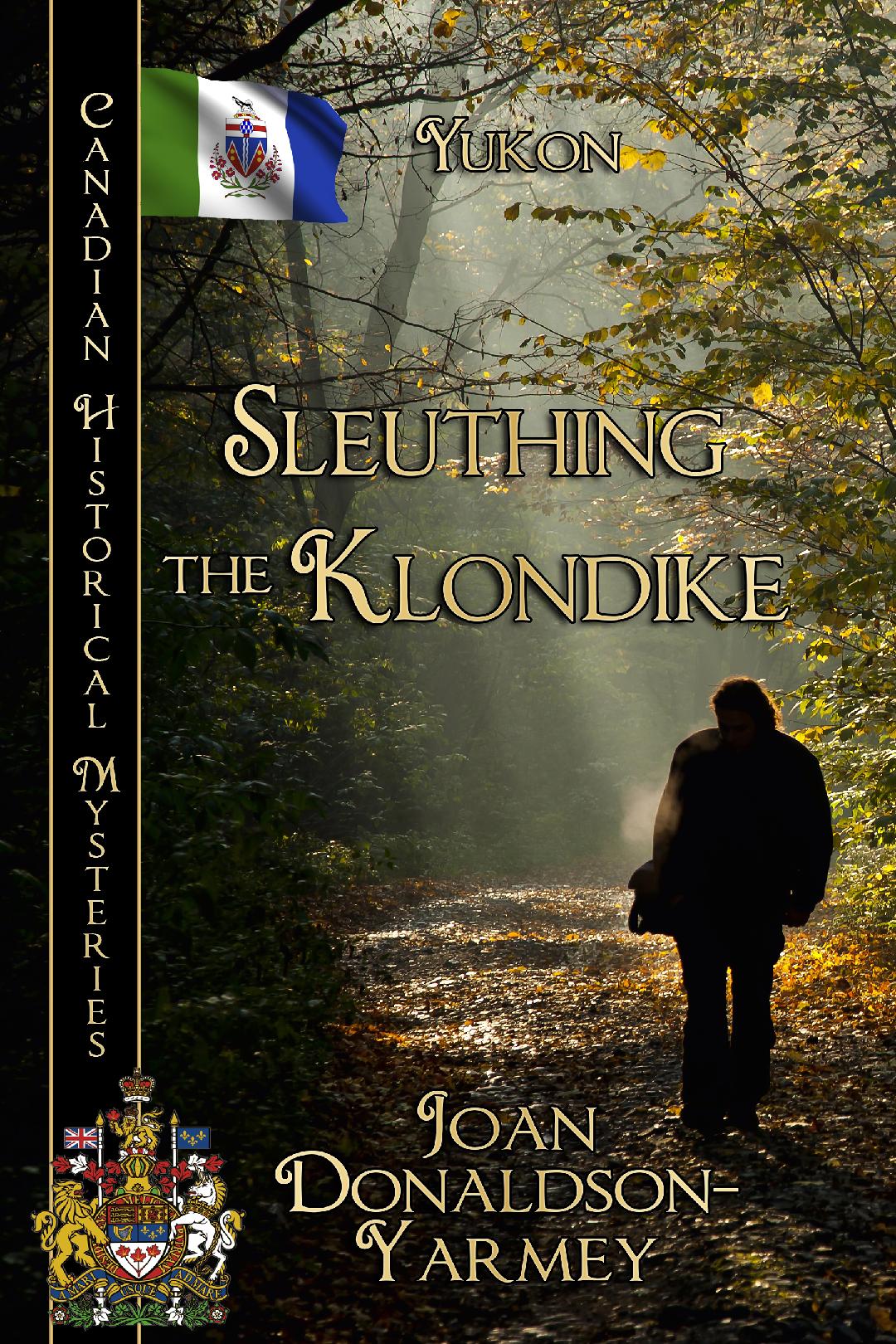
This year BWL, Inc has begun releasing the Canadian Historical Mysteries Collection, which includes twelve mystery novels set in each of the Canadian provinces and territories. My novel, Sleuthing the Klondike, was published in April, 2023 and also takes place in the summer of 1898. Helen Castrel arrives in Victoria, B.C after a long journey from London, England and hires Detective Baxter Davenport to go with her to Dawson City to find her brother. David Castrel is a remittance man who hasn’t been heard from for a year. While the main characters are different from my other two books, their lives become intertwined with the characters of the first Klondike books during their investigation.

The following is a brief history of the Yukon
The name Yukon is derived from the Loucheux first nations word Yukunah which means `big river'. The land was mainly occupied by the Tagish and Tlingit native people for centuries before the non-native explorers arrived in the 1820s. In the 1840s fur traders set up a few Hudson's Bay Company posts along the Yukon River. When the United States purchased Alaska from Russia in 1867, there wasn’t a clear border between Alaska and the Northwest Territories, as the land was known then. In 1887-88 William Ogilvie, a Canadian surveyor, surveyed the area making the 141st meridian the western boundary with Alaska and the 60th parallel the southern border with British Columbia. Hence the phrase North of 60.

     Prospectors went north looking for gold in the 1880s and there was a gold strike along the Fortymile River, which drains into the Yukon River, in 1886. There were other smaller strikes until 1896 when gold was discovered on Rabbit Creek later renamed Bonanza Creek. A town named Dawson sprang up on the Yukon River at the mouth of the Klondike River. When word of the gold discovery reached the outside world in the summer of 1897, thousands of men, women and children hurried to Dawson during the winter of 1897-1898 hoping to find their fortune.

     Because of the rush Dawson grew quickly to be the largest city north of San Francisco and it became known as the `Paris of the North'. It had hotels, dance halls, daily newspapers and saloons for its 30,000 inhabitants. Fresh eggs were brought by raft on the Yukon River; whiskey came in by the boatload before freeze-up; gambling made rich men out of some and paupers out of others; dance hall girls charged $5 dollars in gold for each minute they danced with a miner; the janitors made up to $50 dollars a night when they panned out the sawdust from the barroom floors. Due to the influx of people, the region officially entered into the confederation of Canada and was designated as the Yukon Territory on June 13, 1898. Dawson became the capital. Eventually the word `territory' was dropped and it was called The Yukon.

     A Territorial Administration Building was constructed in 1901 for the territorial seat of government and Dawson was the centre for the government administration until 1953 when the capital was moved to Whitehorse.

     The Klondike gold rush ended in 1899 when word of a gold discovery in Nome, Alaska, reached the prospectors and they headed further north. However, over the next few decades gold companies were formed and continued to mine the creeks, this time using dredges to dig up the creek bottom. They left behind huge piles of gravel called tailings. The dredging lasted until 1960 when gold prices declined making the operation uneconomical. Today, mining is done with big trucks, huge sluices, and back hoes.

     The north is known as the Land of the Midnight Sun after the words in Robert W. Service’s poem The Cremation of Sam McGee:

                    There are strange things done in the midnight sun

                      By the men who moil for gold.

     The Arctic Circle is the most northerly of the five major circles of latitude of the Earth. It is an imaginary line that marks the southern edge of the Arctic at 66 degrees 30' north latitude in the Yukon and Northwest Territories of Canada, and in Alaska, Scandinavia and Russia. The land north of the Arctic Circle gets 24 hours of sunlight on the longest day of the year, June 21st. The further north of the circle you go the more days of total sunlight in the summer you will get. This is because the North Pole is tilted towards the sun and gets direct sunlight from March 20 to September 22 as the earth rotates. Conversely, on the shortest day, December 21st, the land north of the Arctic Circle gets 24 hours of darkness because the North Pole is tilted away from the sun.

     The Yukon is a great place to view the aurora borealis or northern lights. These are bright dancing lights that are really collisions between the gaseous particles of the Earth’s atmosphere and the electrically charged particles from the sun that enter the earth’s atmosphere. The most common colours are pink and pale green produced by oxygen molecules about sixty miles above the earth.  Silver, blue, green, yellow and violet also appear in the display. Red auroras are rare and produced at high altitudes of about 200 miles. The lights are best seen in the winter and the further north you are the better they appear.

     The Yukon has the smallest desert in the world, the Carcross Desert, near the town of Carcross. It is an area that was once covered by a glacial lake. As the glaciers melted the level of the lake lowered until just the sandy bottom was left. Winds off Lake Bennett keep the sand moving and prevent most plants and trees from taking root on this.

     During the late Wisconsin ice age (10,000 to 70,000 years ago) an arid section of the northern hemisphere was not glaciated because of the lack of moisture to support the expansion of the glaciers. The area, called Beringia after the Bering Strait which is near the centre of the region, encompassed parts of present-day eastern Siberia, Alaska, The Yukon, and ended at the Mackenzie River in the Northwest Territories. The growth of continental glaciers sucked up moisture which led to the sea level dropping by up to 106 metres (350 feet). As a result, a land bridge was formed between northwest North America and northeast Asia.

     It is believed that parts of western Beringia (eastern Siberia today) were occupied by man 35,000 years ago. The forming of the Bering Land Bridge allowed the first humans to travel from Asia to North America. There is evidence that the history of man in North America goes back 25,000 years ago.

     Some of the animals that survived for thousands of years in this arid land surrounded by glaciers were the North American horse and camel, the steppe bison, the giant beaver that weighed up to 181 kilograms (400 pounds), the Mastodon, the woolly mammoth, the giant short-faced bear, the scimitar cat, the American lion, and the giant ground sloth. All of these are extinct.

     The territory of The Yukon was founded on gold mining, but there has been coal and silver mining in the territory also. It is now a favourite destination for tourists.

Thursday, June 22, 2023

National Parks and Reserves of Canada


https://books2read.com/u/mKJxdd


 https://books2read.com/u/mYgK6x


National Parks and Reserves of Canada

I am a Canadian writer and all my mystery, historical, romance, and young adult novels are set in Canada. Canada is the second largest country in the world and has forty national parks and ten national park reserves covering an area of approximately 342,000 sq km (132,000 sq mi). This is about 3.2% of Canada’s total land area.

Canada’s first national park, Banff National Park (formerly the Rocky Mountain Park), was created in the province of Alberta in 1885 to protect the land around the Cave and Basin Hot Springs from being developed. Two more parks were created in 1886: Yoho National Park and Glacier National Park, both in the Rocky Mountains in the province of British Columbia. The land for the Waterton National Park, in southern Alberta, was set aside in 1895.

After Waterton it was nine more years before another park was created. The Thousand Islands National Park, which encompasses the one thousand islands of the Islands Parkway on the St. Lawrence River, was established in 1904. These islands are the remnants of former ancient mountains. Then, from 1907, when Jasper National Park was formed, to 2015 when Qausuittug National Park was established on Bathurst Island in Nunavut, forty-four more parks and reserves were created in the ten provinces and three territories. Each park or reserved was formed to protect the habitat of some animal or plant, or for its scenic magnificence. An example is Qautuittug which is the habitat of the endangered Peary Caribou.

One of the features of the parks are red Adirondack chairs. The placing of the red chairs began in Gros Morne National Park in Newfoundland/Labrador in 2011. The members of the park staff positioned eighteen sets of chairs throughout the park and held a contest to see who could find all eighteen sets. The winner won a pair of red chairs. Since then the other parks have followed suit and now there are over two hundred across Canada, all made from 100% recycled plastic.

Some are easily found while others require a bit of a hike. When you find them, sit and enjoy the beautiful view, whether it is overlooking a lake, taking in mountain scenery, enjoying a prairie vista, or listening to a flowing river. The parks offer much to see.

Banff is the most popular park in the country with over four million visitors each year. Tuktut Nogait, in the Northwest Territories, has the least amount of visitors with less than five. A combined total of over fifteen million people view the beautiful scenery of all the parks every year.

Monday, May 22, 2023

From Big To Little


https://www.bookswelove.com/donaldson-yarmey-joan/

https://books2read.com/Romancing-the-Klondike

https://books2read.com/Rushing-the-Klondike

https://www.bookswelove.com/authors/canadian-historical-mysteries/


I am a Canadian writer and all my mystery, historical, romance, and young adult novels are set in Canada. Canada is the second largest country in the world and home to a wide variety of rocks, plants, and animals. Here are some of the oldest, largest, and smallest examples.

Canada’s largest tree is a western red cedar called the Cheewhat Giant. It is in the Pacific Rim National Park on Vancouver Island. It is 56m (182 ft) tall and has trunk diameter of 6m (20ft). The Cheewhat Giant is also the biggest western red cedar in the world.

Canada’s tallest tree is a Sitka spruce in the Carmanah Valley on Vancouver Island. It stands 95m (312ft) high.

Canada has the oldest exposed bedrock on earth and it is the oldest section of our planet’s early crust. It is known as the Nuvvuagittuq greenstone belt and is in Northern Quebec on the eastern shore of the Hudson Bay. It has been analyzed by geologists and they have determined that the rock samples range from 3.8 to 4.28 billion years old. The earth its 4.6 billion years old and there are very few remnants of its early crust, since most of it has been rotated back into the Earth’s interior by the movement of the large tectonic plates over billions of years.

 The Banff Springs Snail isn’t the smallest snail in the world; that is held by the Augustopila psammion species found in a cave in Vietnam and four of them fit inside a grain of sand. However, the only place in the world where the Banff Springs Snail is found is in a handful of thermal springs in Banff National Park in the province of Alberta. The snail was first discovered in 1926 and the largest of the snails are about the size of a small fingernail.

The world’s largest colony of Lesser Snow Geese can be found on the Great Plain of the Koukdjuak on the western side of Baffin Island in the territory of Nunavut, Canada. Beginning in late May as many as two million snow geese migrate there to breed and when the young hatch, they and their parents go further inland to feed. By early September the young are large enough to head south for the winter.

Thursday, May 18, 2023

Everyday Dedication


 https://www.amazon.ca/Sleuthing-Klondike-Canadian-Historical-Mysteries-ebook/dp/B0C18F5D72

I am a Canadian and all my mystery, historical, romance, and young adult novels are set in Canada. Canada (like many countries) has national holidays that are sanctioned by the government and are devoted to famous persons or events. There is usually one a month and most workers have the day off to celebrate it. However, it is a little known fact that each day of the year is dedicated to some animal, or food, or activity. None of them is a recognized holiday but they are worth acknowledging. Here are some for the last part of May.

May 19—National Devil’s Food Cake Day. I love chocolate cake so will be going shopping later.

May 20—Pick Strawberries Day.

May 21—National Waiters and Waitresses Day.

May 22—Victoria Day. This is celebrated in Canada to commemorate Queen Victoria, May 24, 1819 – January 22, 1901. She reigned from June 20, 1837 until her death. At 63 years 216 days she was the longest reigning monarch until Queen Elizabeth II who was on the throne from February 6, 1952 until her death in September 8, 2022.

May 23—Lucky Penny Day. Since Canada doesn’t have pennies anymore I think it should be changed to lucky nickel day.

May 24—National Scavenger Hunt Day.

May 25—Towel Day. Not sure what you are supposed to do with the towel.

May 26-- Sally Ride Day

May 27—National Hugging Day

May 28—Hamburger Day. My hubby is going to like that.

May 29—Memorial Day. It is celebrated in the United States to mourn and honour the country’s military personnel who died while serving in the armed forces.

May 30—Water a Flower Day. They will like it in this heat we are having.

May 31--National Macaroon Day.


I have written three books in what I call Joan’s Historical Yukon Novels: Romancing the Klondike (Historical romance), Rushing the Klondike (sequel to Romancing the Klondike), and Sleuthing the Klondike (historical mystery). All are set during the Klondike Gold Rush 1896-1898. Here is the link to my author’s page at BWL Publishing, Inc. to find these books or any of my other mystery, romance, and historical novels.

https://www.bookswelove.com/donaldson-yarmey-joan/

https://www.amazon.ca/Sleuthing-Klondike-Canadian-Historical-Mysteries-ebook/dp/B0C18F5D72