Showing posts with label #detective. Show all posts

Sunday, March 24, 2024

My Poetry Moment


https://books2read.com/The-Travelling-Detective-Boxed-Set

https://bwlpublishing.ca/donaldson-yarmey-joan/


My Poetry Moment

     Over my writing career I have had articles, short stories, travel books, and mystery, young adult, and science fiction novels published. And one poem. When that one poem was accepted for publication, I felt I had taken my writing to another level. I decided, though, that my contribution was going to be different, that I was going to take the poetry community by storm. I wanted to make my mark, to stand out in the poetry world. And to do that I came up with a new poetry sub-genre that I called Script Poetry. Just like a movie script I set up the scene and the tone for the poem and give some background of the story in the poem by using a script layout. It made the whole poem more visual and that way I could get right to the meat of what I wanted to say.

     I enthusiastically sent out my script poems and waited for the accolades to come in.

     Surprisingly, the publishers were not as galvanized about this new style of poetry as I was. No one accepted them for publication.

     But never underestimate the power of a script poet scorned. At the same time as I was planning my burst onto the poetry stage, I was writing my mystery novel "The Only Shadow In The House," the second book of The Travelling Detective Series. I gave one of my characters the career of a poet and her specialty was Script Poetry. Needless to say the publishers and critics in my fictional world were highly impressed with the poems. The poetry was very popular with the reading public and the poetress won many awards.

     To quote from my book: One critic wrote that her poems have an innovative, revolutionary style that is shaking the foundations of the conventionally staid poetry community, while another critic called them insightful and powerful.

     I have taken one of the script poems from that novel for you to judge for yourself.


Fade In

Act One

Exterior-Farm House-Night.

There is snow on the ground. Stars twinkle in the clear, night sky. A vehicle pulls into the yard and a woman climbs out. She stares at the house then takes a deep breath. She releases it in a vapour. With slow tread she climbs up the steps and enters the darkened house. Inside, she stops and listens.


There is no noise in my house, it is dark and silent.

Today, I buried you. Is this what it is like in your grave,

total quiet, total darkness?

I flip on the light and wander the house

looking at the possessions that

represented a life that never existed,

except in my own mind.

This has been our home for nineteen years

but it now feels alien to me.

Because from now on I know that mine

will be the only shadow in the house.

I must leave here soon.


End Act One

Fade Out


Fade In

Act Two

Interior-Farm House- Night.

All the lights are on in the house. The woman is in the kitchen. She pushes over the shelving holding plant seedlings and pots. She heads to the dining room and goes to a china cabinet with no doors. All the shelves hold figurines and dishes and knick knacks. They crash to the floor with a sweep of her hand. The ones that don’t break, disintegrate under her foot.


“Damn you, Ben. Damned you to hell!” I yell.

I want you to hear. I want you to know

the sorrow and the pain you have brought me.

I go from room to room, expunging.

I spray your shaving cream on the walls.

I dump your aftershave in the tub.

I grab a knife and shred your clothes.

Finally, there is nothing of yours left.

I feel some satisfaction.

You destroyed my life and now I have

destroyed everything that represented yours.

“There you bastard,” I say. “Rot in hell.”


Fade Out

End Act Two


Fade In

Act Three

Interior-Farm House- Night

The woman is standing in front of a picture on the living room wall. The furniture and floor are littered with debris. She takes the picture off the hook and stares at it a long time.


I find our wedding photograph on the wall.

I’d had it enlarged for our tenth anniversary

as my loving gift to you.

Were you as pleased as you said you were

or was that just a sham?

I smash the glass against the corner of the table.

I cut my finger removing the shards.

I look at you smiling back at me.

Were you an impostor in our marriage?

For now I wonder how many other

women did you see over our nineteen years.

I slash the picture with the knife. How symbolic.


End Act Three

Fade Out

Wednesday, September 1, 2021

Some Alberta History


http://www.bookswelove.com/donaldson-yarmey-joan/

Some Alberta History

I began my writing career as a travel writer and I drove and camped through all of British Columbia, Alberta, the Yukon and Alaska, writing about what there was to see and do in those provinces, and the territory and state. I learned a lot of history, saw a lot of beautiful scenery, and met a lot of wonderful people.

My first mystery (Illegally Dead) of my Travelling Detective Series is set along the Crowsnest Highway in Southern Alberta

The following is about Fort Macleod, along the Crowsnest Highway, from my travel book the Backroads of Southern Alberta. Fort Macleod, coincidently, is the setting for the novel, Illegally Dead, the first book of my Travelling Detective Series boxed set.

After the Hudson's Bay Company sold Rupert's Land to the Canadian Government in 1869, fur traders from Fort Benton in Montana travelled north into present day Alberta and set up illegally trading posts called Whiskey Forts. They brought wagon loads of whiskey and guns to trade for furs with the natives. The watered down whiskey, laced with any or all of Tabasco, red pepper, tobacco, ginger, molasses, tea, sulphuric acid and ink, drove the natives wild and they brutalized and killed their own tribesmen, other bands, and some whitemen. Sir John A Macdonald, prime minister of Canada at the time declared that the area should be safe for settlers moving west and he formed the North West Mounted Police (NWMP) in 1873. The next year they marched west and established Fort Macleod, which is southern Alberta's oldest settlement.

The downtown district, on 24th Street between Second and Third Avenues, was declared Alberta's first provincial historical site on May 14, 1984. There are many wood frame buildings that date back to 1890s and some brick and sandstone ones from the early 1900s.
The Empress Theatre opened in 1912 and was used for vaudeville acts, minstrel shows, silent films, political rallies and talking films. It has been renovated, but the original pressed metal ceiling, double seats in every second row, and the old radiators remain. The Empress Theatre Society presents movies or live performances during the summer.
The present-day Fort Macleod is a reproduction, but some of the log buildings inside the Fort Museum are original and house numerous historical native and North West Mounted Police-Royal Canadian Mounted Police artifacts. A Musical Ride is staged four times a day during July and August. Young men and women dressed in replica North West Mounted Police uniforms present an exhibition of horsemanship and precision, similar to the world famous Musical Ride.

Harry `Kanouse' Taylor, a former whiskey fort owner, set up a hotel in Fort Macleod after the arrival of the NWMP-the original name of the RCMP. Due to the changing times and transient population, there had to be certain rules in his hotel. They were:
1. Guests will be provided with breakfast and dinner,
but must rustle their own lunch.
2. Spiked boots and spurs must be removed at night
before retiring.
3. Dogs are not allowed in bunks, but may sleep
underneath.
4. Towels are changed weekly; insect powder is for sale
at the bar.
5. Special rates for Gospel Grinders and the gambling
profession.
6. The bar will be open day and night. Every known fluid,
except water, for sale. No mixed drinks will be served
except in case of a death in the family. Only
registered guests allowed the privileges of sleeping
on the bar room floor.
7. No kicking regarding the food. Those who do not like
the provender will be put out. When guests find
themselves or their baggage thrown over the fence,
they may consider they have received notice to leave.
8. Baths furnished free down at the river, but bathers
must provide their own soap and towels.
9. Valuables will not be locked in the hotel safe, as
the hotel possesses no such ornament.
10. Guests are expected to rise at 6:00 a.m., as the
sheets are needed for tablecloths.
11. To attract the attention of waiters, shoot through
the door panel. Two shots for ice water, three for
a new deck of cards.
No Jawbone. In God We Trust; All Others Pay Cash.


Thursday, September 13, 2018

If I Could Go Back In Time

If I could go back in time, where would I go? I was born and raised in Canada where our non-native history goes back almost 400 years if you look at what is now the province of Quebec or 1000 years if you count the Vikings having a settlement in what is now the province of Newfoundland.

In 2017, I travelled across Canada to the site of the Viking settlement at L’Anse Aux Meadows on the tip of Newfoundland’s Great North Peninsula. There I toured through the encampment which consisted of replicas of the timber and sod buildings constructed by the Vikings who had sailed from Greenland. I talked with the costumed interpreters who were sitting around a fire inside one of the buildings cooking their meal. It felt surreal to be there, to know that my ancestors (I have recently found out that I have Viking heritage) lived there for a few years. This is the first known evidence of European settlement in the Americas. From the camp, I walked along the rugged cliffs overlooking the Atlantic Ocean and crossed a large bog on a boardwalk. Then I toured the museum, looking at the fascinating artifacts that were found during the excavation. The site was declared a UNESCO World Heritage Site in 1978.


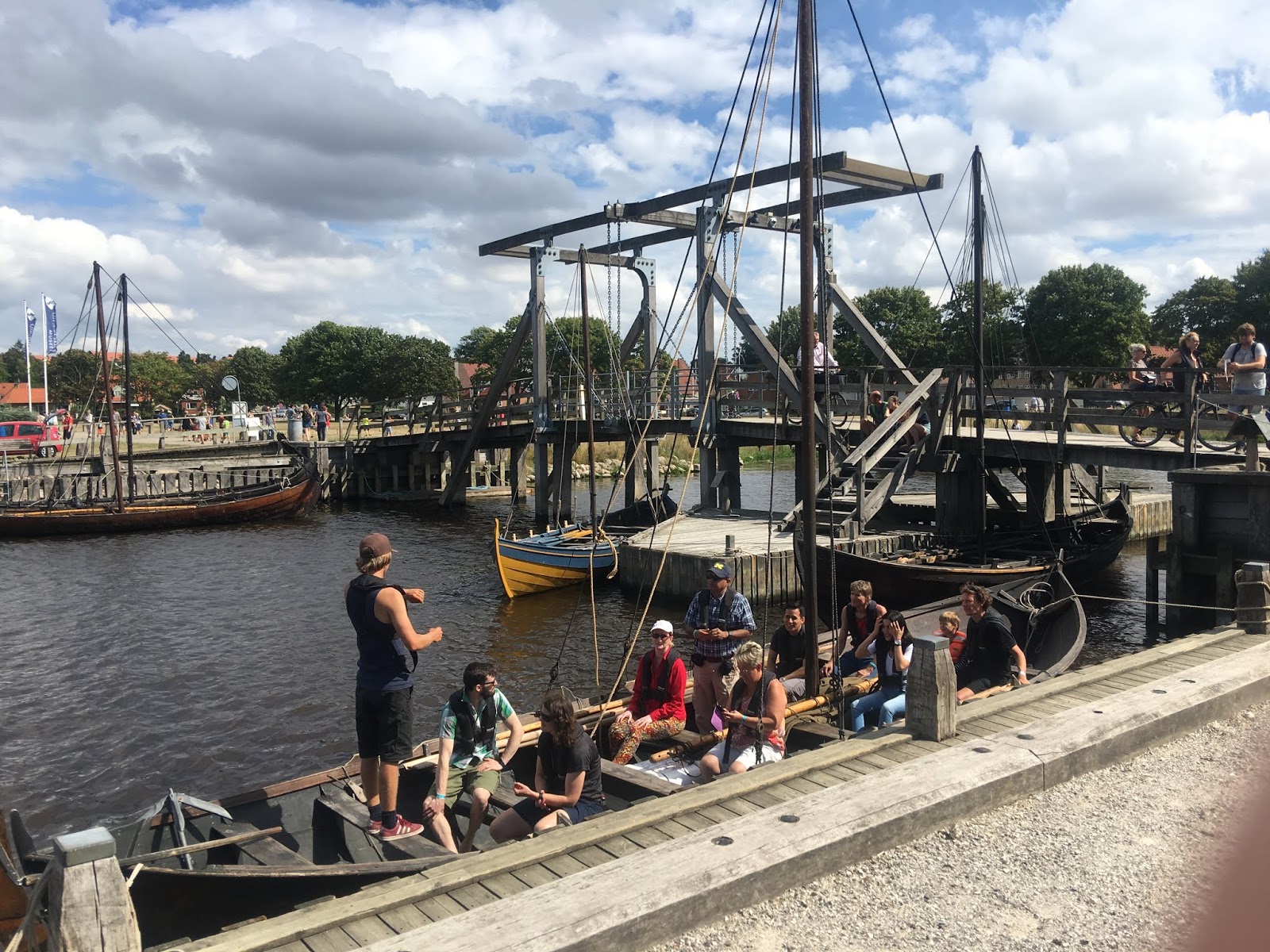
This year I spent 66 days in Europe and one of the places I visited was the Viking Ship Museum in Roskilde, just outside Copenhagen, Denmark. In the museum is a permanent exhibition of parts of five original Viking ships excavated nearby in 1962. A thousand years ago these ships were deliberately scuttled (filled with rocks and sunk) in a river to stop the enemy from invading the city by water. Over the decades since they were found, the pieces have been preserved and put together on a metal frame to show how the ships would have looked. Also at the site are replicas of the Viking ships and I became a Viking for an hour. A group of us sat on the seats and rowed the ship out of the harbour using the long oars. Once on the open water we hoisted the mast and set sail. After sailing for a while we headed back to the harbour. As we neared it I had the honour of pulling on the rope that lowered the mast and sail and we glided back to our dock.


So if I could go back in time I would like to be a Viking Shield-Maiden. Women of the time were not called Vikings because they normally did not take part in warfare. They were called Norsewomen. However, women fought in a battle in 971AD and Freydis Eiriksdottir, Leif Erikson’s half-sister is said to have grabbed a sword, and, bare-breasted, helped scare away an attacking army. These women were called Shield-Maidens.

http://bookswelove.net/authors/donaldson-yarmey-joan/
 

Wednesday, June 13, 2018

Remembering Our Gold Claim


                                                     Our Gold Claim

 In the late 1930s my father, Oliver Donaldson, and his brothers, Gib and Albert, made their living by panning for gold on two gold claims on the Salmon River, now called the Salmo River, south of Nelson, British Columbia. In 1980, Dad, my Mom, my husband Mike, our five children, and I went on a holiday to the Salmo River and the site of the former claims. We found the bottom two rows of logs, all that was left of one of the cabins they had lived in and the second cabin, which was still standing, on the other side of the river.

       Under Dad’s direction we all panned the river. The children were quite excited at finding gold to take home. We toured the area seeing the route Dad and his brothers had taken into town to sell their gold and to buy some staples and where they had hunted for deer and picked apples to live on. After the trip, Mike and I had vowed that someday we would return.

       In the spring of 1992, Mike, and I found ourselves preparing for a death and a wedding in our family. At the beginning of that year, Mike’s oldest sister Sallian had been diagnosed with terminal pancreatic cancer and one of our sons and his fiancé had set a wedding date. For almost five months we visited Sallian, first at home and then in the hospital. I cannot describe the anger, sorrow, and frustration I felt as I watched what the disease was doing to her. She lost weight and the ability to look after herself. During her final month she was hardly more than a skeleton.

       For those same five months I experienced a mother’s delight and happiness as I helped with the marriage plans. I made the cake, watched my son pick out his tuxedo, found my dress, arranged for my hairdo, and planned a mixed shower of friends and family.

       Balancing my life while dealing with the opposing emotions was truly hard.

       Sallian died on May 25 at age 54. On June 27 over 300 people attended the wedding and partied well into the night.

       Like most people it took the death of someone close to me to make me realize how important really living is. I knew Mike and I had to do something adventurous with our lives, something out of the ordinary.

       That summer of 1992 we decided to leave life as we knew it in Spruce Grove, Alberta, and get a gold claim in southern British Columbia, preferably in the Nelson area. We sold our house and quit our jobs. For our new home we bought a used twenty-four foot holiday trailer. I phoned the Minerals Branch of the B.C. government. They sent us a map showing the separate gold claim regions of southern B.C. We picked out three regions, Salmo being one, and I called back requesting more detailed maps of the staked claims in those areas.

     On September 1, we began our journey west. Mike was pulling the holiday trailer with our half-ton truck, which had our all-terrain vehicle in the back. I was in our smaller four-wheel drive pulling a utility trailer with our prospecting equipment and other paraphernalia we thought we might need.

       It took two days of slow travel to reach the Selkirk Motel and Campsite on the side of the highway at Erie, about three kilometres west of the town of Salmo. We set up camp, hooking up to the water and power. We had until freeze-up to find a claim.

       Next morning we were up early and off to the Gold Commissioner’s Office in Nelson where Mike bought a Gold Miner’s Certificate and received two red metal tags, and a topographical map, and was given his recording form. We were hopeful as we headed back to the campsite.

       According to the maps the Salmo River was all staked so over the next two weeks we checked rivers and creeks in the area with little success. But the Salmo River kept calling us and we returned to Dad’s former claim and the remains of his old cabin. Just past it we stood on the bluff looking down on the river as we had done twelve years earlier with my parents and our children. The memories came flooding back: the walk to the river with each child carrying a pie plate to use as a gold pan, finding gold only to discover that we had nothing to put it in, one daughter coming up with the idea of sticking it to bandages, camping near the river.

       But we didn’t have time to linger. We were working against the weather. Mike went over our maps of the Salmo River again and this time noticed that there is a small portion on the curve of the river near the old cabin that was open. Because the claims on either side formed rectangles it was missed by both of them. We found the posts of those claims then hurried to Nelson to confirm that the piece was available. It was.

       It was possible to lay one claim over part of another but the first one had priority for that section enclosed in it. There wasn’t time to stake it that night so we had to wait until morning. We rose early, went out to the river and put one of Mike’s red tag on the post of the claim to the east of ours. Mike took a compass and orange flagging and we began to mark off the distance, tying the flagging to trees as we went. At the end of five hundred yards Mike cut a tree, leaving a stump about three feet high. He squared off the top and I nailed up our final tag with the information scratched by knife point onto it. The claim was five hundred yards by five hundred yards and was called the Donaldson.

       We hurried back to Nelson and handed in the recording form. We were ecstatic. Not only had we located an area on the same river as my father, but we actually had part of his old claim. We went to the river and found a clearing for us to set up camp the next spring. Mike took his gold pan and headed down to the water’s edge.

       I followed and sat on a large rock. As I watched the water flow sedately by, a deep sense of relaxation settled over me, the first I had felt since the beginning of the year. It helped me begin to deal with the fact that I had witnessed Death at work.

       Sallian was the first one in either of our immediate families to die. I had seen the tragedy of death strike my friends but didn’t understand how devastating it could be until it happened to me.

       We spent the winter in our trailer in Vancouver visiting with my sister, my aunt, and some cousins.

       Near the end of March we drove out of Vancouver eager to get back to our claim. We pulled our trailer in and set up a campsite was in the middle of tall pine, birch, spruce, and cedar. We could just barely see the mountain tops to the south. The mountains to the north were higher and made a lovely backdrop to the trees. In the morning I walked through the bush to the river. I sat on a large triangle-shaped rock and watched the water drift by. A partridge drummed in the distance. Birds sang in the trees. I took a deep breath of the cool, fresh air. It was a good place to be.

       It rained just about every day for the next couple of weeks. We sat under the trailer awning and listened to the drops hitting the canvas. Sometimes the awning sagged with the weight of the water and we had to empty it. Sometimes we let it overflow, creating a waterfall.

       Rain or shine it became my morning ritual to go to the river before breakfast. I loved to sit on my rock and stare at the water. Because of the rains and the snowmelt in the mountains the river level was rising each day. Soon I was watching logs and other debris rush past in the torrent. The water dipped over some boulders, and created a backwash when it hit others. The force of the water was mesmerizing.

       One rare sunny day we went for a walk down the road past our camp. I carried my camera. A short distance from camp we saw spring water seeping out of a hole under a large rock in the embankment beside the road. Mike reached in the hole to feel how big it was and found a bottle of wine. It had been opened at one time and then put in there to keep cool. Mike set it back.

       We followed the long, hilly road as it wound its way through trees and past cow pastures. On our way back we encountered a herd of deer. They did some scrambling to get into the bush while I did some scrambling to take pictures. They were faster than me. We reached the spring and Mike decided to set up a water system. He went for a pail and a hose. When he returned he put one end of the green hose into the hole and soon water began to trickle out of the other end. He let it run for a while to clean the hose then filled the pail. Mike carried the pail back to camp. We had fresh water for our camp.

       There was always activity around us. We heard rustling and cracking in the bush and it wasn’t unusual for a deer to trot through the clearing at any time of the day. Birds sang, a woodpecker occasionally tapped on a tree, partridge thumped, and trees scratched and rubbed against each another in the wind. All day and night there was the thundering of the boulders as the whirling river water rolled and bumped them against each other.

      As the days warmed the air became filled with the scents of pine and cedar, sweet wild flowers, and the intertwined fragrances of the bush. Colours sprang up, from pink roses, white dogwood and hazelnuts, and purple and yellow flowers, to the bright green of the ferns. Butterflies flitted throughout the clearing and there was the buzz of flies and mosquitoes and the drone of bees. The few rainy days were humid and the clouds never stayed long. Sometimes the moon at night lit up the clearing and we sat by the camp fire in the soft light.

       With the rains and spring run-off over, the river level began dropping. I sat on my favourite rock and watched the slower, shallower water flow by. The roar was gone. In the peace and tranquillity I was able to think about death. As best I could, I acknowledged that many of the people I loved would probably die before me, though I found it harder to actually accept the fact.

       Mike and I spent time digging dirt from around rocks in the water and working it in the pan. We found enough small flakes to keep us trying.

       But soon our adventure was over and by summer’s end we were back in the real world. We never did find much gold but then, for me, it really wasn’t about the gold.
 
       I based one of my mystery novels, Gold Fever, on this experience. My historical novel, Romancing the Klondike, published by Books We Love, Ltd, is also based on the search for gold in the Yukon.

Wednesday, September 13, 2017

Support of my Writing


My family and friends have been very supportive of me during my writing career. When my first two non-fiction books were published, my parents would look for them in bookstores. If they found them with only their spines showing they rearranged the books on the shelves so that the covers of mine were facing out so they could be seen easier.
 
My husband is constantly telling people that I am a writer and where they can find my books. My parents, siblings, children, and grandchildren have come to book launches, sat with me during a book signing, and passed on advertising information about my new books through social media and other means.

When they were younger my grandchildren helped out at some of my launches: acting as doormen by opening doors for customers at bookstores, singing, or playing a saxophone or flute during the interlude before my reading.
 
I have some friends who buy and read all my books and continually tell me how much they like them.

Thank you to my family and friends for your continued encouragement.